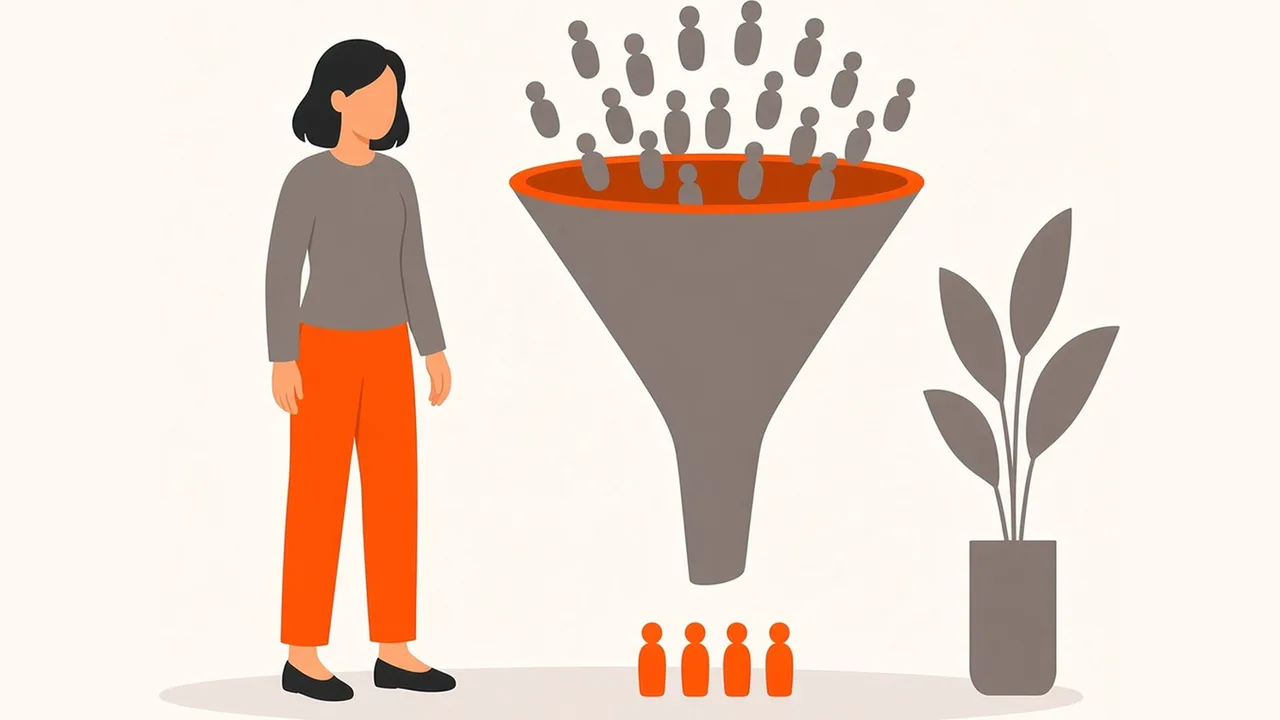
A marketing funnel is a simple way to describe the path someone takes from first hearing about you to enquiring, buying or becoming a repeat customer. It is a model, not a machine. People do not actually march through a tube. The picture just helps a small business see which work is for people who barely know you, and which work is for people who are close to choosing.
Our marketing strategy work uses that kind of thinking, without turning it into a 40-page diagram nobody opens again.
A plain definition
At the wide end are people who have a problem or a job to do, and may not know your name yet. Some of them will pay attention. Fewer will compare you with someone else. Fewer still will get in touch or buy. That narrowing is why it is called a funnel.
The same idea sometimes appears as a sales funnel. In a small business the two often overlap, because the same people are writing the pages, running the ads and answering the phone. The useful distinction is only this: marketing is usually the work that creates awareness and interest, and sales is the work that turns a serious enquiry into a job. If you are a team of five, you do not need two separate diagrams.
The usual stages
There is no official set of names. Plenty of versions exist. For a small UK business, four stages are enough:
- Awareness. Someone discovers you: a search, an ad, a recommendation, a press mention or a post.
- Interest. They want to understand what you do, usually on your site or in an email.
- Consideration. They compare options, look for proof and weigh the risk of choosing you.
- Action. They enquire, book, buy or start a trial.
Some teams add a fifth stage for staying in touch after the first job. That is worth doing, but it is a relationship, not another slide in a deck.
What the model is for
The funnel is most useful when it stops you using one message for every audience. A content marketing guide that answers a first question is awareness or interest work. A comparison page, a clear price signal or a case-style story is consideration work. A focused landing page and a straightforward form are action work. Email marketing often sits in the middle, staying useful to people who already know you.
PPC can play at more than one stage, which is why a search ad for a buying term should not send people to a vague homepage. If the click is close to a decision, the page should help them take it. Our note on turning visits into enquiries covers that last stretch.
The model also shows drop-off. Some drop-off is healthy: not everyone who reads a guide is a buyer. Trouble starts when people who were ready to enquire cannot do it, or when all your effort sits at the wide end and nothing supports the people who are already interested.
Keep it light
You do not need special software to "build a funnel". You need a short list of the questions people ask at each stage, a place to send them, and a way to enquire. Our older piece on the three pillars of a digital marketing strategy is about choosing channels. This post is only about the path those channels are meant to support.
If the path is unclear, that is a strategy problem, not a design one. A fractional CMO can help when nobody in the business owns that path. If you want the role explained first, start with what a fractional CMO is.
If you only do one thing after reading this, write down the last five enquiries you won and the last five you lost, and mark the stage where each person got stuck. That short list is more useful than a prettier diagram.
Frequently asked questions
What is the difference between a marketing funnel and a sales funnel?
They describe the same journey from slightly different jobs. Marketing usually covers awareness and interest. Sales usually covers the conversation that turns a serious enquiry into a customer. In a small business, one team often does both.
How many stages should a marketing funnel have?
As few as you will actually use. Four stages (awareness, interest, consideration, action) are enough for most small businesses. Extra stages only help if they change what you publish or measure.
Is the marketing funnel outdated because buying is not linear?
People do jump about, come back months later or skip a stage. The funnel is still a useful planning tool, as long as you treat it as a model and not as a claim that every customer follows the same route.